Planning to get ahead - Utilising an Asset Schedule
Some images may not show clearly on mobile. For best viewing please read on a laptop screen or bigger.
Time to read: 6 minutes.
Like many professional and personal endeavours, financial success is often driven by proper planning. Before you can even begin on your plan you need to focus on where you are, otherwise, you won’t be able to outline the steps you need to take to get where you want to be.
At Method, our success is our clients’ success, and we always start at the same place: completing an
Asset Schedule
Fill in your details below to download your own copy
While this is a very simple step, we believe it is vitally important for each and every one of our clients. Any plan is comprised of 3 key elements:
· Where you are
· Where you want to be
· How to get there
With any plan if you are missing any of these key elements you are either at the mercy of your own luck or doomed to fail without an understanding of why.
Even if you know where you want to be and how to get there, you still need to know where you are!
Our Asset Schedule allows anyone to get a quick glance of their current position, and this forms the bedrock of any successful financial plan.
Ok, so how do I use this ?
At first glance, our Asset Schedule can be daunting, and you may not believe you have the information to even start to fill in your data, however, with any journey you have to take the first step.
Step 1 – Categorisation
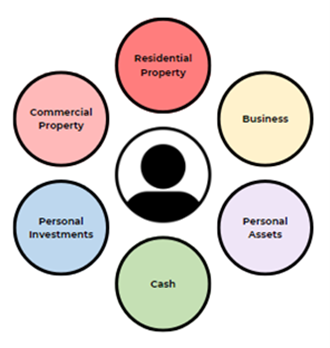
Our agreed first step is to categorise your assets. We typically use the following asset classes:
These asset classes should encompass any holdings you may have acquired during your lifetime.
Be it a holiday home, a commercial office space, your workplace pension, or even a limited-edition Rolex watch, these assets are all included on your schedule.
The main idea here is to start thinking about what assets are liquid, and what assets are illiquid:
· Liquid assets are readily available and would typically be classified as personal investments, and cash.
· Illiquid assets are more difficult to access capital from and would typically be classified as residential and commercial property, businesses, and certain personal assets.
This is just a simple guideline, and you will have some assets are that not immediately or obviously categorised. Assets such as pensions have limitations around access, and alternative investments could have a set time horizon.
Step 2 – Evaluating
Once you have noted down your assets, and started to categorise these you should start the process of evaluation. Simply put this is assigning a value to your assets. For some assets you own you may have difficult in assigning a value, however, some assets will be much easier to evaluate. Please note:
· Your liquid assets are more likely to have a set valuation.
· Your illiquid assets are more likely to have subjective valuations.
It is important to be honest with your assessments and use third party evaluations where possible.
The second part of evaluation is considering any debt, or liability secured against these assets. For example, many people will have debt secured against a property purchase, reducing the available capital realisable on sale, and this should be factored into your schedule.
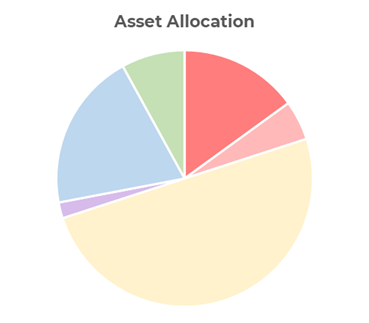
At this stage you will have the net value for each of your assets, and a simple categorisation, giving you an overview of your asset allocation.
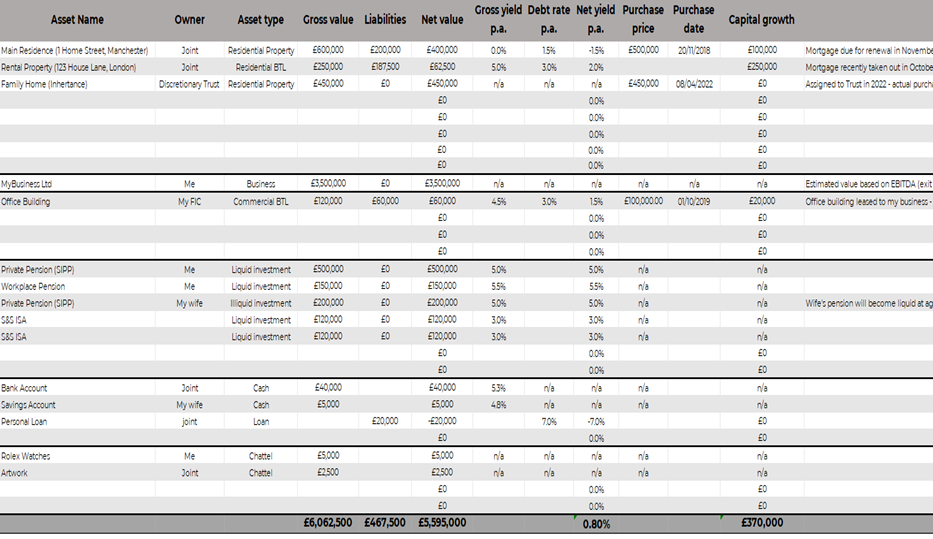
The final part to the evaluation step is to work out the net yield on each of your assets. To do this you need to input the current yield in relation to any asset, and then any corresponding debt rate. For a bank account the current yield would be the interest received, and for a rental property this would be the annual rental income net of fees and costs as a proportion of the gross value.
The debt rate applicable would be any corresponding mortgage interest rate, or the repayment rate against any leveraged asset. This should only include the interest on borrowing, all costs and fees should be accounted for in the net income used to calculate the gross yield.
You should have something similar to this:
Step 3 – Forecasting
Now that the Asset Schedule is complete, it can be used to complete a forecast. You may be accumulating your wealth for the future, or even have a specific major life event on the horizon, but this 2-year projection is focused on short term cash flow and liquidity needs.
Please note, this is not designed to project the value of your assets over time.
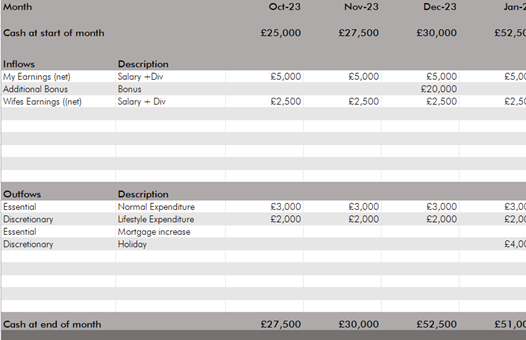
The idea here is to breakdown your expected inflows and outflows.
Any forecast is to relay information you know into a more digestible format. If you are honest, and thorough the more informative and accurate this short-term forecast will be.
Keep in mind this is only a 2-year forecast and should not substitute longer term modelling options, instead understanding your short-term cash needs helps to strengthen long-term investment targets.
The output from this model is displayed graphically similar to the below image:
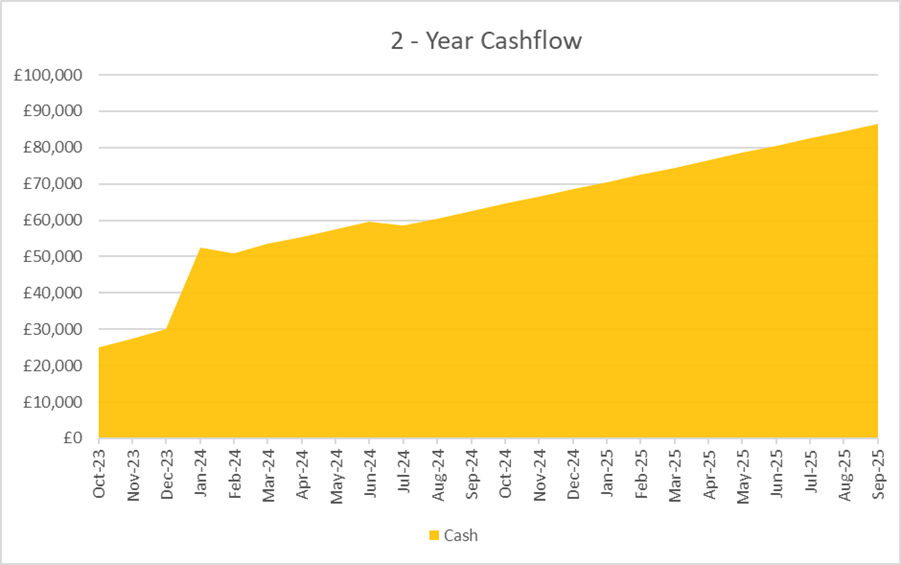
If your 2-year cashflow highlights a deficit, you may need to realise capital from your existing assets. Always consult with a professional adviser when consider decumulation options as there could be wider financial and tax implications.
This guide should help you to use our Asset Schedule. The Asset Schedule is the start of knowing where you are and a platform to think about your long-term objectives. Download your own copy and get started on your own Asset Schedule today!
If would like to chat to a member of the team at Method do not hesitate to get in touch by following the links on the website. Whether you want to talk about getting started on your own Asset Schedule, or even how to realise some of your financial objectives, we are happy to help.